Peoria County sits in a climate zone that delivers roughly 26 freeze-thaw cycles per year on average, according to the National Weather Service Lincoln, IL office data for the region. Every one of those cycles forces…
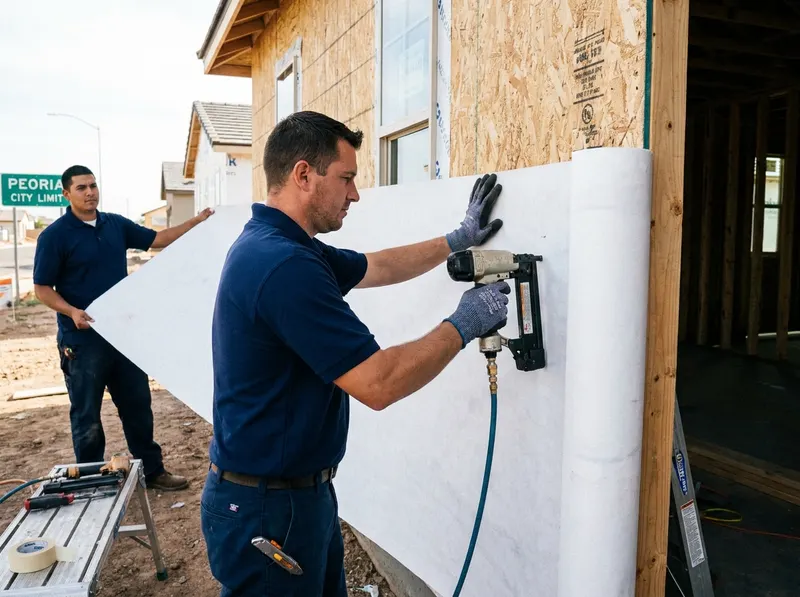
Peoria County sits in a climate zone that delivers roughly 26 freeze-thaw cycles per year on average, according to the National Weather Service Lincoln, IL office data for the region. Every one of those cycles forces water that has infiltrated a wall assembly to expand and contract inside the sheathing. Homes built in the 1960s through the early 1990s, the era that defines most of the housing stock in Kellar Heights, Glen Hollow, and Sheridan Village, were wrapped with felt paper or early asphalt-saturated barriers that degrade over 25, 30 years. By the time vinyl or aluminum siding shows chalking or seam separation on the exterior, the barrier underneath has often already failed at the laps, around window flanges, or at utility penetrations. Installing new siding over a failed barrier traps that moisture problem inside a fresh assembly.
The installation sequence matters more than the product brand. Sealwell Siding Services follows a four-step process on every Peoria job: (1) remove existing cladding and photograph the full substrate before any material is ordered; (2) probe and document any soft, delaminated, or water-stained sheathing panels, a common finding in North Valley and Alta Terrace homes where original T1-11 or fiberboard sheathing was never replaced; (3) install the WRB starting at the base course and lapping each subsequent course over the one below by a minimum of 6 inches horizontally and 12 inches at vertical seams, consistent with IRC Section R703.2; (4) flash all rough openings with self-adhered flashing tape before window flanges are set. The Building Science Corporation has documented that improperly lapped or untaped seams account for a significant share of wall assembly moisture failures in cold-climate zones, the kind of failure that shows up as interior mold or rotted framing years after the siding looks fine from the street.
Homeowners in Springdale and Heading Hills sometimes ask whether a higher-perm wrap is worth the added cost. U.S. Department of Energy guidance on wall assemblies notes that vapor permeance of the WRB must be matched to the climate zone and insulation type to avoid trapping moisture on the wrong side of the wall. Peoria sits in IECC Climate Zone 5A, which generally favors a vapor-permeable, Class III or Class II WRB on the exterior so that any moisture that enters the assembly can dry to the outside. A non-perforated wrap can be appropriate in specific assemblies, but the choice depends on what insulation is present behind the sheathing, a detail confirmed during the substrate inspection, not assumed from the street. The National Roofing Contractors Association and the Vinyl Siding Institute both publish installation guidelines that specify WRB requirements as a prerequisite to a valid siding installation warranty. Without a properly installed barrier, most siding manufacturers' warranties are void.
A non-obvious cost item: if sheathing panels need replacement, typically $55, $120 per 4×8 panel installed, depending on material and story height, that work happens between barrier removal and wrap installation and is quoted separately from the WRB line item. Homeowners in Lakeview and Prospect Heights with aluminum siding original to the home frequently find one to three panels of damaged OSB once the old cladding comes off. The American Wood Council publishes span and nailing schedules for structural sheathing replacement that Sealwell Siding Services follows when panels are swapped. The project lead documents every replaced panel with a photo and includes it in the written scope summary left with the homeowner at job completion. For permit requirements on wall assembly work in Peoria, the City of Peoria Community Development Department issues building permits for exterior re-cladding projects; Sealwell Siding Services pulls the applicable permit before work begins. OSHA 1926.502 fall-protection standards apply to any work above 6 feet, which affects staging setup on two-story homes in Richwoods and Kellar Heights. Material performance data for common WRB products is maintained by the WrapCode industry resource and by individual manufacturers whose technical data sheets are available through the Building Products Digest trade library.
Every job gets a firm, written price after a free on-site visit.
For standards, safe disposal, and service guidance on Siding Services in Peoria, IL, useful references include U.S. Dept. of Energy, ENERGY STAR, HUD, OSHA, U.S. Green Building Council, and Google Maps. General consumer and small-business resources are available from USA.gov, Better Business Bureau, FTC Consumer Advice, U.S. Small Business Administration, and Ready.gov.
Tell us about your housewrap and weather barrier installation job in Peoria and we'll send a clear, written quote, usually the same day.
 Sealwell Siding Services